
Beyond Math: What Vertical Learning Can Offer the ELA Classroom
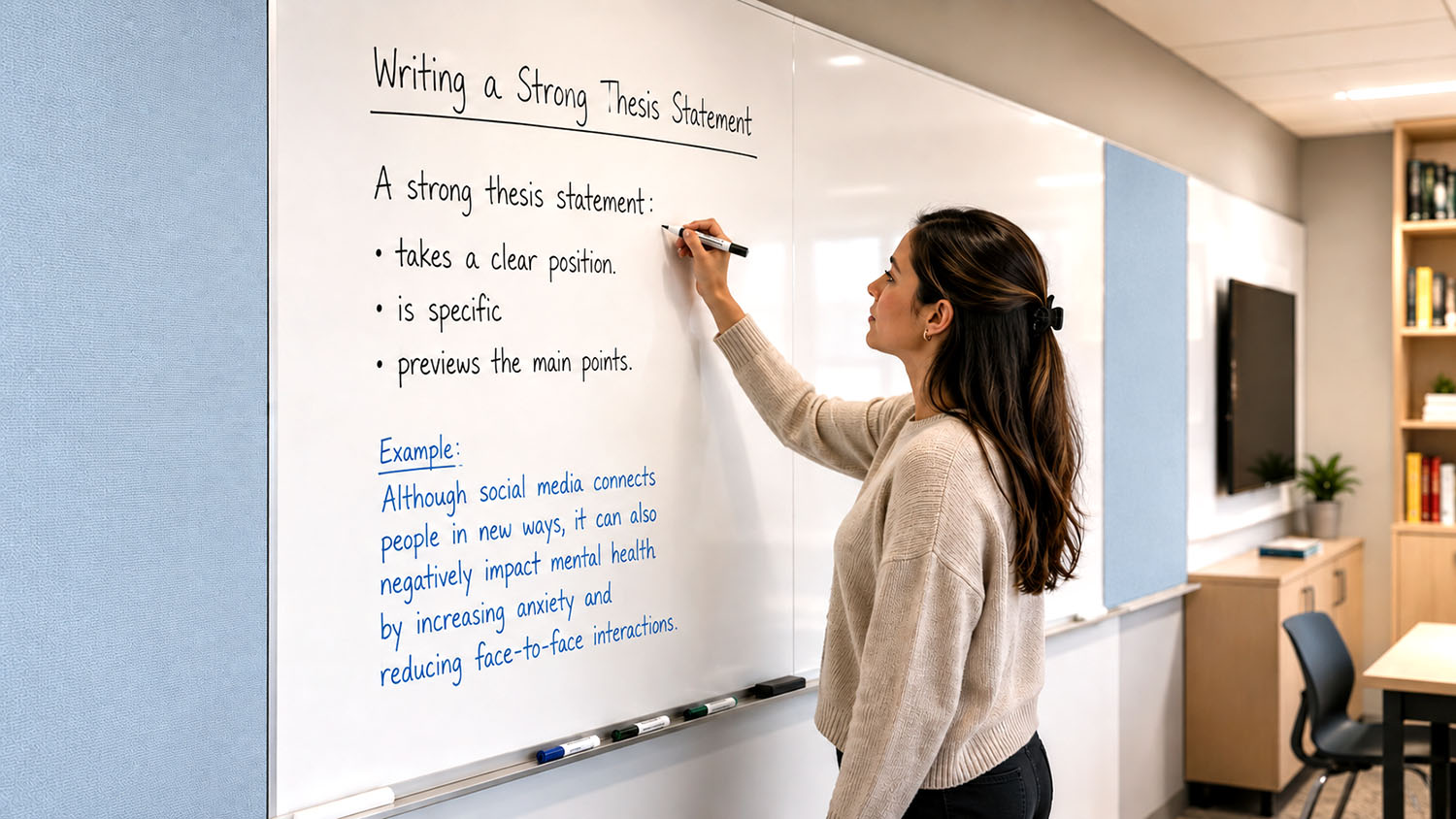
Vertical collaboration may be most visible in mathematics, but the behaviors it supports are not subject-specific.
English Language Arts asks students to interpret, question, compare evidence, build arguments, choose language, revise ideas, and respond to one another. Much of that work becomes more powerful when students can see not only a final answer, but the thinking that produced it.
For Platinum, the opportunity is not to make an ELA classroom look like a math classroom. It is to ask a spatial question: what kinds of surfaces and working zones help students make language and interpretation visible?
What kinds of surfaces and working zones help students make language and interpretation visible?
Make Interpretation Visible
ELA often deals in meaning rather than a single correct solution. A student may make a claim about a character, choose evidence, revise an interpretation after discussion, or realize that the same passage can support more than one reading.
Shared writable space gives that thinking somewhere to live outside an individual notebook or screen. A group can place a claim in the center, build evidence around it, connect themes, identify questions, and revise the wording as its understanding changes.
The value is not the marker or board by itself. The value is that the reasoning remains visible long enough to be examined, challenged, and improved.
Give Discussion a Visual Memory
Class discussion is powerful, but spoken ideas disappear quickly. Once a comment is made, students have to remember it, record it, or let it go.
A shared surface can give discussion a visual memory. Important language, competing interpretations, evidence, questions, and connections can remain visible while the conversation continues.
That can make it easier for a group to return to an earlier idea, compare what changed, or notice that two comments are actually connected.
The room begins to support not just conversation, but the accumulation of thought.
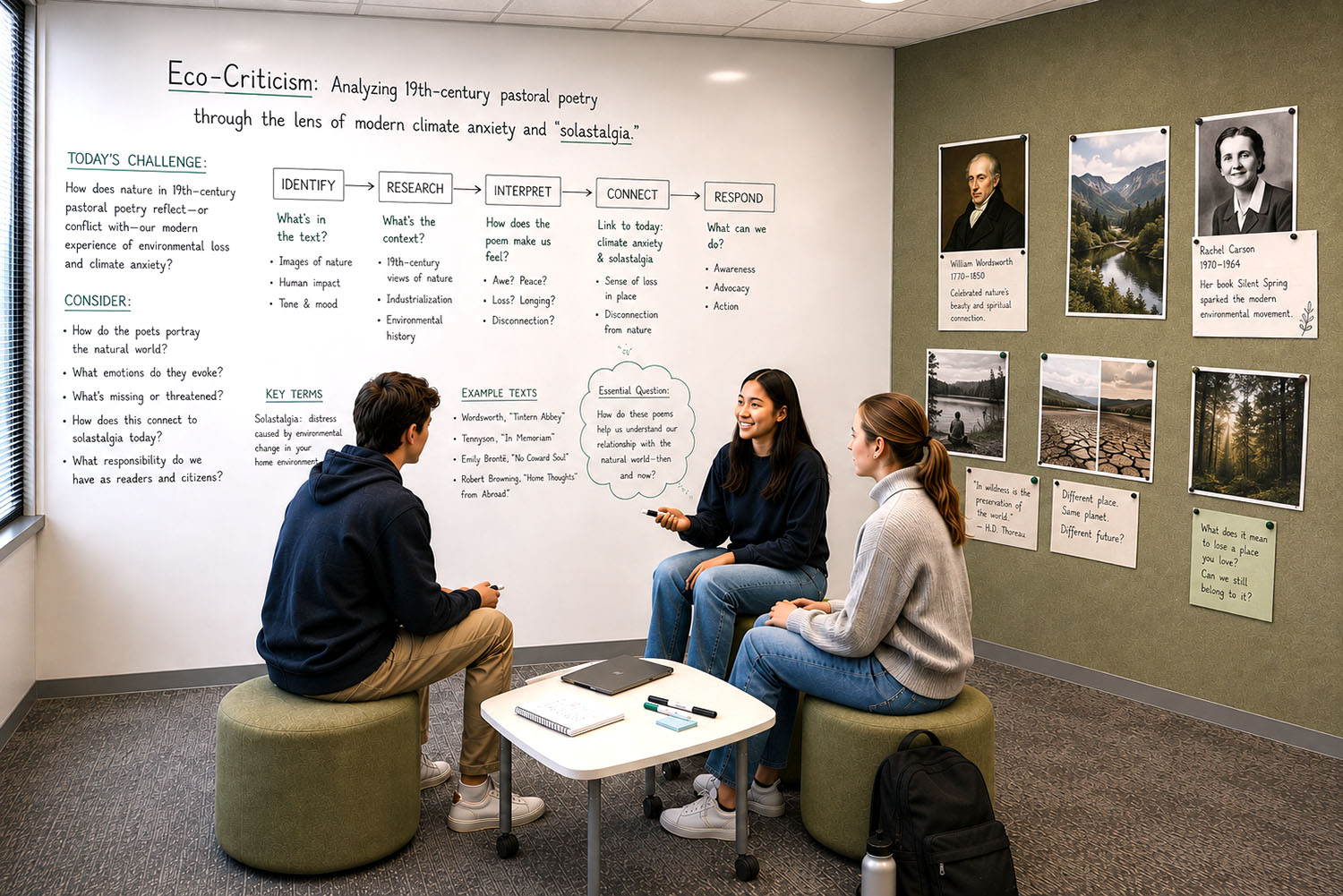
The room begins to support not just conversation, but the accumulation of thought.
Close Reading Can Become a Shared Workspace
Close reading does not have to become a group activity from beginning to end. But some stages of analysis benefit from being externalized.
A passage can become the center of a shared map of significant words, patterns, evidence, questions, inference, tone, and theme. Different groups can work with different excerpts or perspectives and then compare what they found.
The spatial benefit is that multiple interpretations can remain visible at once. Students are not simply told that a text can be read in different ways; they can see those differences taking shape around the room.
Revision Belongs in the Environment
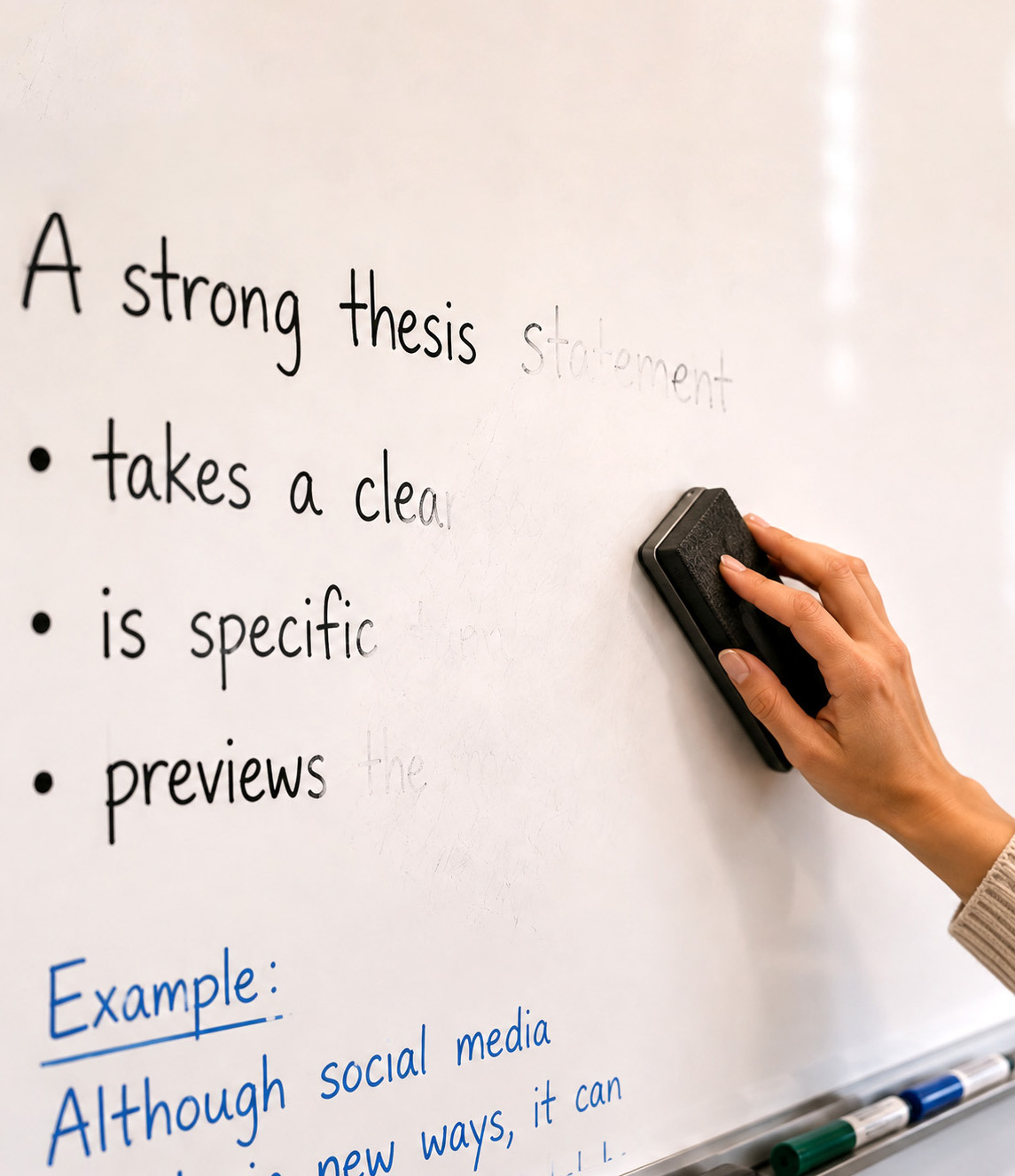
ELA is built around revision. Words change. Claims become more precise. Evidence is reordered. An argument may strengthen, weaken, or take a new direction.
An erasable surface supports that mindset because the first version does not have to feel final. Students can move an idea, replace a word, restructure an argument, or remove something that no longer holds up.
That makes the workspace behave more like the writing process itself: provisional, visible, and open to change.
Use Color and Space to Organize Meaning
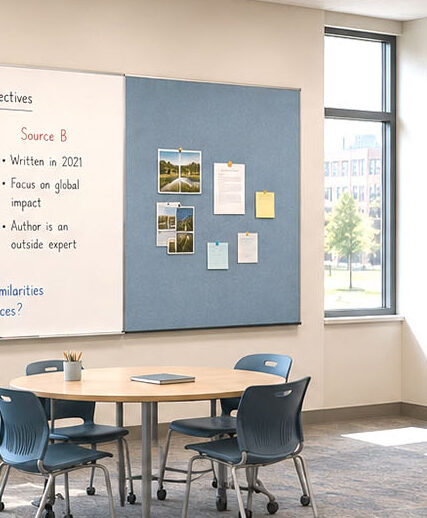
ELA work often asks students to manage several kinds of information at once. A visual workspace can help organize those layers.
Color can distinguish claim from evidence, observation from question, or one speaker’s interpretation from another. Spatial arrangement can show hierarchy, sequence, comparison, or connection.
Used intentionally, the board becomes more than a place to write sentences. It becomes a tool for organizing meaning.
Movement Can Create Multiple Points of Entry
Distributed writable surfaces also create opportunities to structure the room differently.
One area might hold a theme question. Another might focus on a passage. Another could ask students to strengthen an argument or respond to a peer interpretation.
Students can move between zones, add to existing thinking, compare perspectives, and return to their own work with new information. The room can support several conversations without requiring all of them to happen at the same presentation wall.
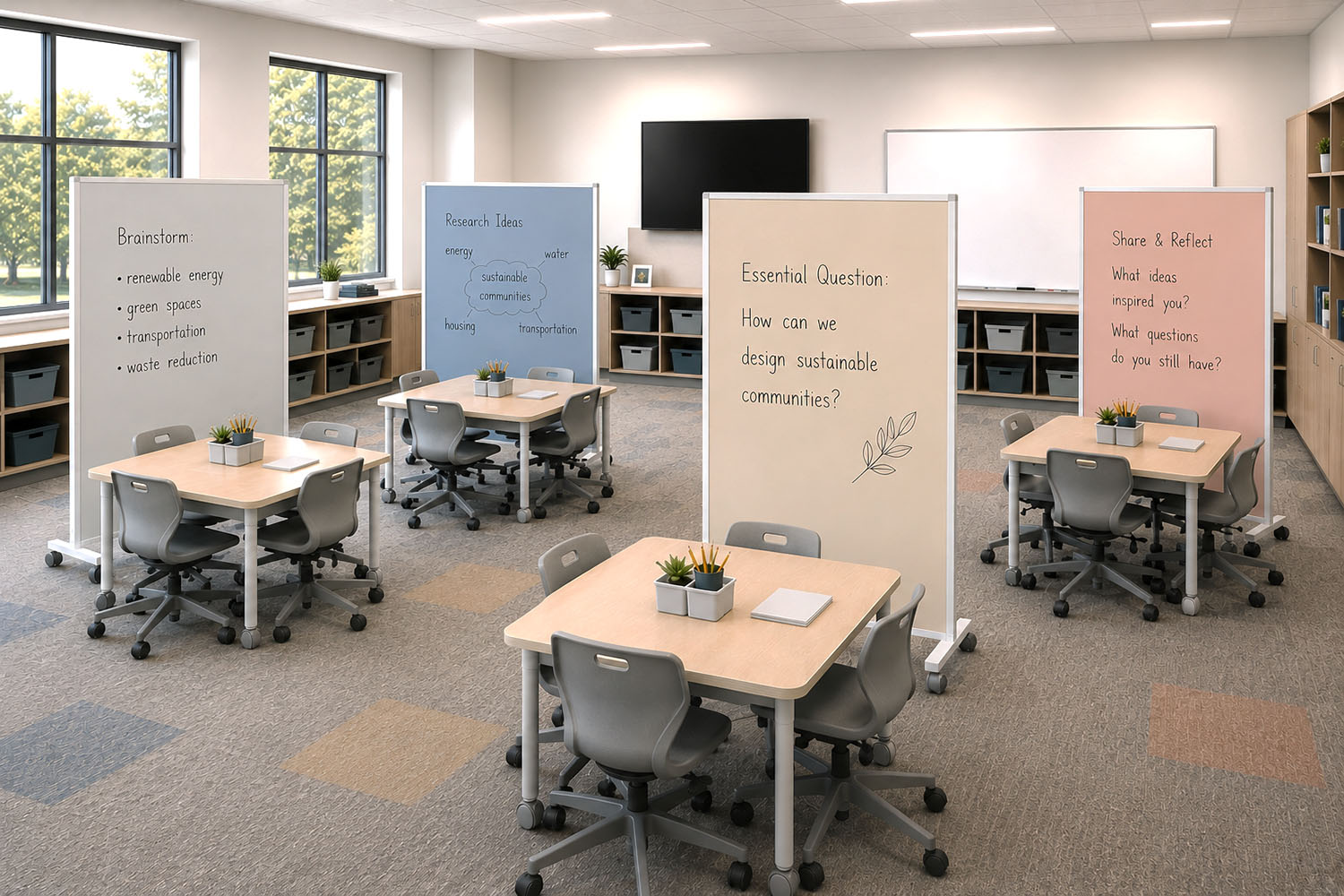
Design the ELA Room Around What Students Do
At Platinum, the subject label matters less than the activity the room must support.
Do students need to compare evidence side by side?
Will small groups develop arguments at the same time?
Does the room support movement between discussion and writing?
Can ideas remain visible long enough to revisit and revise them?
Is there enough writable space for several groups without crowding one another?
Can the teacher see and respond to work developing across the room?
Those questions lead to the same principle we use throughout visual workspace planning: the surface should follow the behavior.
A Classroom Does Not Need One Center of Attention
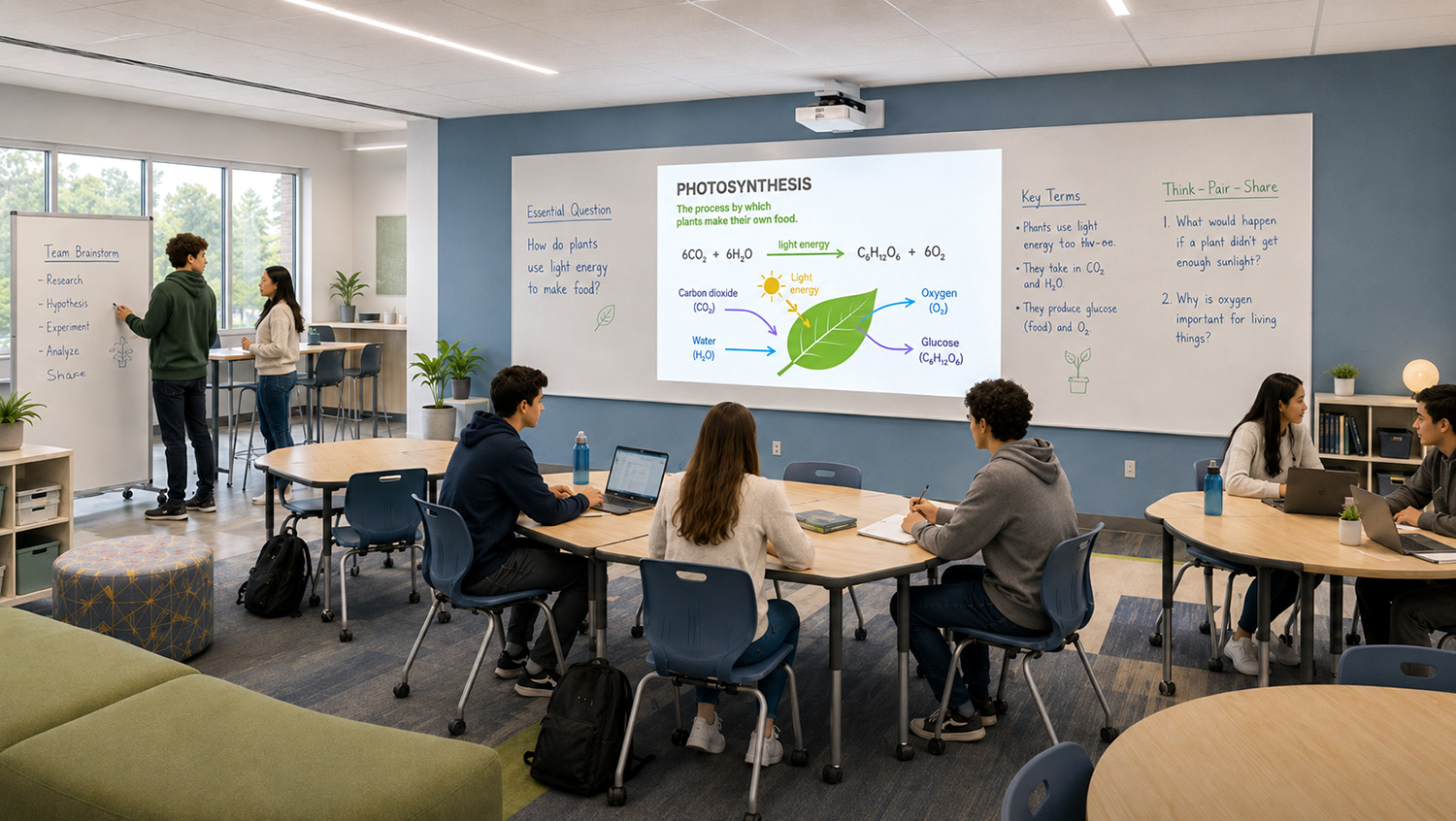
Whole-group instruction still matters, and a primary presentation wall can remain important. But it does not need to be the only place where visible work happens.
When writable space exists in several locations, the room can move more naturally between listening, discussion, collaborative analysis, writing, and review.
That creates a classroom with multiple working zones instead of one permanent center of activity.
Give Language Somewhere to Develop
Vertical learning does not replace books, notebooks, essays, discussion, or digital tools. It adds another mode of working.
For ELA, that mode is especially useful when ideas need to be compared, organized, challenged, or revised collectively.
A classroom wall can display finished student work. It can also become a temporary workspace where meaning is still being made. That is the larger opportunity: giving language and interpretation enough space to develop in public before they become final.
Evidence & Further Reading
Going Vertical in ELA — The Teaching Factor
An educator’s perspective on bringing vertical learning into the ELA classroom, with applications for reading, writing, discussion, feedback, and collaborative learning.
Vertical Learning with Classroom Walls — Community Playthings
Explores how classroom walls can become active learning spaces, expanding opportunities for students to engage, collaborate, move, and interact with their environment.
Lasting Effects of Creating Classroom Space: A Study of Teacher Behavior
A study examining how changes to classroom space can influence teacher behavior and the ways educators use the physical learning environment.
Continue the Conversation
Interested in learning more about the research behind evidence based learning environments?
Schedule our Designing for Visual Acuity and Cognitive Clarity CEU to explore how neuroscience, cognitive psychology, and intentional design can improve learning outcomes.
Or explore Platinum’s integrated vertical learning solutions designed to support active, collaborative, and future ready classrooms.
Share
Newsletter
Sign up for our newsletter to get the latest updates and insider news.